Since the start of 2025, the number of temporary residents entering Canada has been steadily declining. According to July statistics recently released by Immigration, Refugees and Citizenship Canada (IRCC), 18,500 new workers entered Canada during July 2025 alone, a significant 37% decrease compared to 29,595 during the same period last year. International students showed an even steeper decline. The number of new student arrivals, which was 17,140 in July 2024, fell to 7,685 this year, a decrease of more than half (55%).
This means that in July alone, 20,550 fewer new workers and international students entered Canada compared to the same month last year. This is not merely a seasonal factor, but rather a result of the Canadian government systematically restricting entry under its goal to reduce the number of temporary residents to below 5% of the total population.
This downward trend has been clearly evident since the beginning of this year. From January to June 2025, new international student arrivals plummeted by 70% compared to the same period last year, while new worker arrivals also decreased by over 50%. The July statistics confirm that this trend continues unabated.
On a cumulative basis, the number of students and workers newly arriving in Canada from January to July this year decreased by approximately 235,000 compared to the same period in 2024. In July alone, 26,185 temporary residents arrived, a decrease of about 7.3% compared to the previous month of June (28,245).
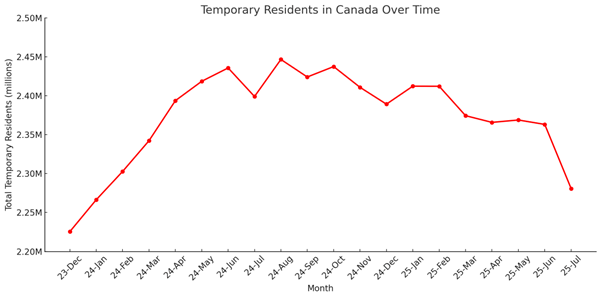
Temporary resident levels in Canada continue to decline
Comparing the number of foreign students and workers currently residing in Canada reveals a clear structural shift. As of July 2025, there were 499,365 foreigners in Canada holding valid study permits, a decrease of nearly 120,000 from 619,070 in the same month last year. Compared to the previous month of June, the number also decreased by over 47,000.
Meanwhile, the foreign population holding work visas shows a somewhat different pattern. As of July 2025, 1,494,905 individuals are residing on work visa status, an increase of 71,000 (approximately 5%) compared to the previous year. However, compared to June, there was a slight decrease (1,504,575 → 1,494,905).
This phenomenon is also a natural progression. This is because international students typically transition to worker status after obtaining a Post-Graduation Work Permit (PGWP) approximately 3 to 4 years after graduation. In other words, the sharp decline in study permit issuance after 2024 is highly likely to lead to a decrease in work permits starting around 2028.
The number of individuals holding both study permits and work permits is also declining. Multiple permit holders, which stood at 356,380 in July 2024, decreased to 286,465 in the same month this year, showing a clear downward trend compared to the previous month of June (312,010). The total number of temporary residents in Canada has been steadily declining since reaching its peak in August 2024 (2,446,523). As of July 2025, it has decreased by approximately 3% compared to the previous month.
This decline in temporary residents is not merely a statistical change but a result of policy intent. Since early 2024, the Canadian government has implemented a policy to gradually reduce the total number of residence permits issued, stating that “excessive temporary resident populations are a major factor in housing shortages and rising prices.” In fact, during the first quarter of 2025 (January to April), Canada's overall population growth rate was only 0.0%, and the number of temporary residents decreased by 61,111.
Political debate is also heated. Recently, Conservative Party Leader Pierre Poilievre argued that the Temporary Foreign Worker Program (TFWP) should be completely abolished, criticizing that “the government has failed to meet its immigration targets.” He cited the figure of 105,000 TFWP work permits issued in the first half of 2025, but in reality, over 70,000 of these were renewals or extensions for existing residents. New entrants numbered only 33,700, just 41% of the government's target (82,000 annually).
In reality, the majority of work visa holders in Canada enter through the International Mobility Program (IMP), not the Temporary Foreign Worker Program (TFWP). According to the 2025–2027 Immigration Levels Plan, 285,750 new arrivals are projected through the IMP in 2025, while new arrivals through the TFWP are set at 82,000. However, next year, in 2026, the target for new arrivals through the IMP is set to be reduced by a significant 55% (to 128,700). While the TFWP target is expected to remain frozen, overall temporary resident inflows are projected to decrease substantially.
This direction indicates that Canada is shifting away from its “population expansion policy centered on international students and temporary workers” for the time being, toward a “selective immigration structure focused on settlement-ready workers.”
CanNest Immigration does not view this change as a mere reduction in the program. It also signals Canada's intent to enhance the quality of long-term residents and increase their chances of obtaining permanent residency.
Between 2026 and 2027, even if temporary visa issuance decreases, individuals already studying or working in Canada are expected to have a higher chance of securing settlement opportunities through permanent residency pathways such as Express Entry, Provincial Nominee Programs (PNP), and the Refugee Class Immigration Program (RCIP).
In other words, now is the time to “strategize your stay rather than just entry.” For those studying or working, timing and program selection for permanent residency conversion are more critical than ever. CanNest Immigration will design the optimal strategy tailored to your individual circumstances, ensuring a clear path forward even amid changing regulations.



Since the start of 2025, the number of temporary residents entering Canada has been steadily declining. According to July statistics recently released by Immigration, Refugees and Citizenship Canada (IRCC), 18,500 new workers entered Canada during July 2025 alone, a significant 37% decrease compared to 29,595 during the same period last year. International students showed an even steeper decline. The number of new student arrivals, which was 17,140 in July 2024, fell to 7,685 this year, a decrease of more than half (55%).
This means that in July alone, 20,550 fewer new workers and international students entered Canada compared to the same month last year. This is not merely a seasonal factor, but rather a result of the Canadian government systematically restricting entry under its goal to reduce the number of temporary residents to below 5% of the total population.
This downward trend has been clearly evident since the beginning of this year. From January to June 2025, new international student arrivals plummeted by 70% compared to the same period last year, while new worker arrivals also decreased by over 50%. The July statistics confirm that this trend continues unabated.
On a cumulative basis, the number of students and workers newly arriving in Canada from January to July this year decreased by approximately 235,000 compared to the same period in 2024. In July alone, 26,185 temporary residents arrived, a decrease of about 7.3% compared to the previous month of June (28,245).
Temporary resident levels in Canada continue to decline
Comparing the number of foreign students and workers currently residing in Canada reveals a clear structural shift. As of July 2025, there were 499,365 foreigners in Canada holding valid study permits, a decrease of nearly 120,000 from 619,070 in the same month last year. Compared to the previous month of June, the number also decreased by over 47,000.
Meanwhile, the foreign population holding work visas shows a somewhat different pattern. As of July 2025, 1,494,905 individuals are residing on work visa status, an increase of 71,000 (approximately 5%) compared to the previous year. However, compared to June, there was a slight decrease (1,504,575 → 1,494,905).
This phenomenon is also a natural progression. This is because international students typically transition to worker status after obtaining a Post-Graduation Work Permit (PGWP) approximately 3 to 4 years after graduation. In other words, the sharp decline in study permit issuance after 2024 is highly likely to lead to a decrease in work permits starting around 2028.
The number of individuals holding both study permits and work permits is also declining. Multiple permit holders, which stood at 356,380 in July 2024, decreased to 286,465 in the same month this year, showing a clear downward trend compared to the previous month of June (312,010). The total number of temporary residents in Canada has been steadily declining since reaching its peak in August 2024 (2,446,523). As of July 2025, it has decreased by approximately 3% compared to the previous month.
This decline in temporary residents is not merely a statistical change but a result of policy intent. Since early 2024, the Canadian government has implemented a policy to gradually reduce the total number of residence permits issued, stating that “excessive temporary resident populations are a major factor in housing shortages and rising prices.” In fact, during the first quarter of 2025 (January to April), Canada's overall population growth rate was only 0.0%, and the number of temporary residents decreased by 61,111.
Political debate is also heated. Recently, Conservative Party Leader Pierre Poilievre argued that the Temporary Foreign Worker Program (TFWP) should be completely abolished, criticizing that “the government has failed to meet its immigration targets.” He cited the figure of 105,000 TFWP work permits issued in the first half of 2025, but in reality, over 70,000 of these were renewals or extensions for existing residents. New entrants numbered only 33,700, just 41% of the government's target (82,000 annually).
In reality, the majority of work visa holders in Canada enter through the International Mobility Program (IMP), not the Temporary Foreign Worker Program (TFWP). According to the 2025–2027 Immigration Levels Plan, 285,750 new arrivals are projected through the IMP in 2025, while new arrivals through the TFWP are set at 82,000. However, next year, in 2026, the target for new arrivals through the IMP is set to be reduced by a significant 55% (to 128,700). While the TFWP target is expected to remain frozen, overall temporary resident inflows are projected to decrease substantially.
This direction indicates that Canada is shifting away from its “population expansion policy centered on international students and temporary workers” for the time being, toward a “selective immigration structure focused on settlement-ready workers.”
CanNest Immigration does not view this change as a mere reduction in the program. It also signals Canada's intent to enhance the quality of long-term residents and increase their chances of obtaining permanent residency.
Between 2026 and 2027, even if temporary visa issuance decreases, individuals already studying or working in Canada are expected to have a higher chance of securing settlement opportunities through permanent residency pathways such as Express Entry, Provincial Nominee Programs (PNP), and the Refugee Class Immigration Program (RCIP).
In other words, now is the time to “strategize your stay rather than just entry.” For those studying or working, timing and program selection for permanent residency conversion are more critical than ever. CanNest Immigration will design the optimal strategy tailored to your individual circumstances, ensuring a clear path forward even amid changing regulations.